Purple Dimension


Success Stories
Blind Sided
The Setup
I was already at my wit’s end. My business partner hadn’t paid me in weeks, so I was in our office, irritated, grinding away on building our virtual desktop infrastructure. Then my phone blew up.
He was frantic, begging me to meet him onsite at a local Fortune 100 client. I flat-out refused. I hadn’t been paid, and servicing corporate clients wasn’t even my side of the house. But he kept pleading, desperate, insisting that if I didn’t show up right now, our business would cease to exist.
Fine. I relented.
When I pulled up, he was waiting in the parking lot. Weird. Why isn’t he inside? Security hastily whipped up a temporary badge for me—another massive red flag, considering the usual intense vetting process for a company this size. We stepped into the elevator in silence.
600 Eyes
The doors slid open on the top floor. The secretary took one look at us, her face completely petrified with fear. She scrambled for her phone, and within seconds, the Vice President appeared. Not our usual tech contact. The VP.
The man was an absolute mess—breathing heavily, sweating profusely, his hand clammy as he briefly shook mine without even making eye contact. He quickly badged us through the secure doors.
We stepped onto the main floor. On a normal business day, this room housed 300 busy noisy cubicles. Today, it was dead silent. Not a single mouse click. No keyboard keys. No phone calls. Even the printers were silent. Instead, 600 eyes stared at the three of us in agonizing anticipation.
The VP turned to us, desperation in his voice:
“How long is this going to take? We are losing $1 million for every hour we are down. We’ve already been down for three.”
I glared at my partner behind the VP’s back as I realized he “forgot” to mention to me that the entire corporate office was offline and that this was a Code Red situation. This guy.
The Gauntlet
With the pressure mounting, we walked the gauntlet through the sea of staring employees until we reached the tech cubicles. I had to pass a row of seven in-house IT guys, all scoffing and glaring at me because they had all already tried—and failed—to fix the problem themselves.
Bracing myself, I approached the workspace to hardwire into the network.
The Fix
With the clock ticking and millions on the line, I became the eye of the storm. I took control, coordinating with four remote technicians physically stationed in a data center 1,000 miles away who acted as my hands-on support. Meanwhile, back in the room, the seven skeptical in-house tech guys were shoulder-surfing my screen, watching my every move.
The crowd was closing in so tight that my partner at one point had to intervene:
“Guys, can you please take a step back and give us some room?”
I tuned out the noise, focused entirely on hardware and virtual appliances, network routing, and configuration.
The Win
Within the hour, the silence was broken by the sharp ring of a telephone. The entire corporate network surged back to life.
The Vice President was almost in full sprint coming toward us. His hand was raised high above his head, eyes wide with pure, unadulterated relief, coming in hot for a high five.
As if on cue, the tension in the room evaporated. The entire floor erupted into applause, clapping and cheering as if I had just won a championship challenge.
The VP, beaming, looked at us and said:
“Nice work! I guess I won’t have to find a new job. Dinner is on me. Where would you like to go?”
Sports Arena
High-Stakes Architecture: Two Rivals, One Roof
We were contracted to architect, build, label, and document a massive multi-tenant network infrastructure for a major professional sports facility. The core challenge was security: hosting two distinct professional organizations on a single physical footprint, ensuring complete data isolation between rivals while maintaining seamlessly shared common services.
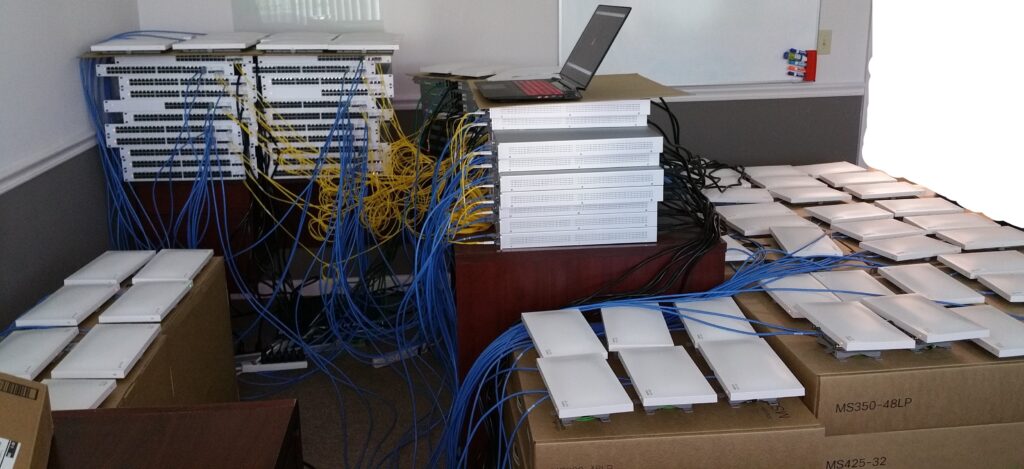
We ended up having to run a web of extension cords through the entire building just to keep the hardware online to stage it.
In a spectacular twist of fate, both of those rival teams actually went on to face each other in the ultimate championship game at the end of that regular season. While the athletes get the credit for the sweat and the hustle, I like to believe that our superior, rock-solid technology gave them the informational edge they needed to outperform they rest of the league.
Beast Mode
M&A Integration & AWS Architecture
We partnered with a private equity firm to architect and deploy a comprehensive AWS Organization following the Well-Architected Framework, building a secure foundation for a national enterprise generating over $700 million in run-rate revenue. Operating across all 50 states with a footprint of 14,000+ employees and over 30,000 locations, this massive ecosystem seamlessly manages 42+ AWS services across 9 accounts daily.
Our team spearheaded the complex M&A technical consolidation of 18 separate companies under a single corporate entity. This involved migrating 150 domains and executing custom ETL processes to transition heterogeneous databases into a unified environment. We engineered a layered topology—fully documented via a detailed digital blueprint—that integrates advanced security tools like GuardDuty and AWS WAF with heavy-duty data handling engines like Amazon Aurora and Redshift.
During this same period, we worked in tandem to develop the enterprise’s core production work order management system, built natively within AWS to handle high-volume operational workflows.
Today, this robust infrastructure powers a massive integration hub of 13 production APIs, synchronizing 50,000 daily data points across national ERP and CRM systems. From foolproof “Go-Live” playbooks to bi-directional Jira security integrations, we built this ecosystem to serve as a rock-solid, highly scalable foundation for massive-scale national operations.